Time, space, energy
Agents live in regions, cross geography, draw energy from land and fossil stocks, and face climate pressure as history unfolds pulse by pulse.
The Crucible is a world simulation where designed tribes live through complete artificial histories. They compete, cooperate, reproduce, build civilization, collapse, and try to survive the future they create.
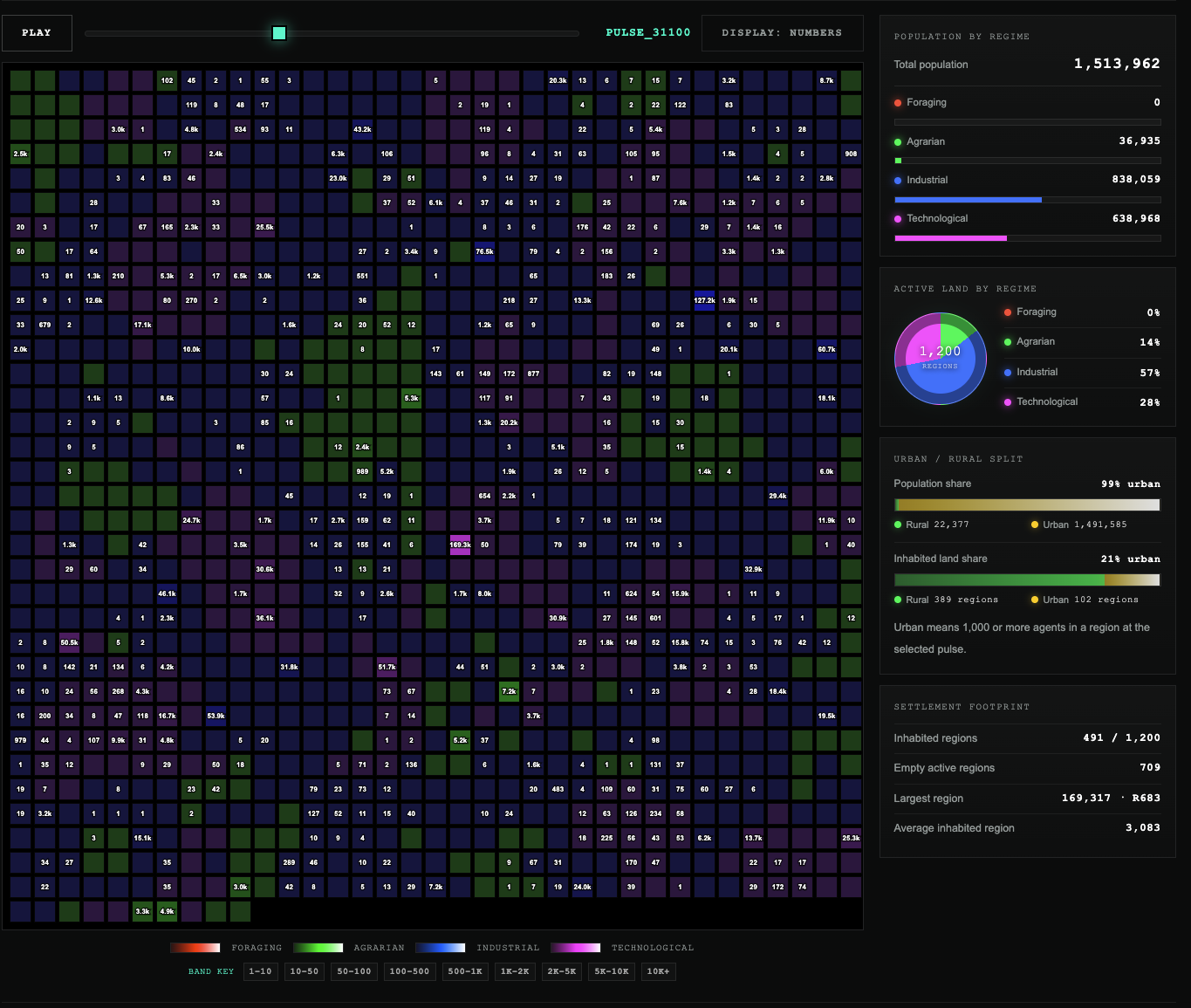
In the Crucible, each epoch is one complete simulated history, each pulse is one step through time, and each tribe begins with inherited traits that shape survival, trust, movement, and reproduction.
Agents live in regions, cross geography, draw energy from land and fossil stocks, and face climate pressure as history unfolds pulse by pulse.
Each founder carries 33 inherited numeric parameters shaping survival, trust, forgiveness, opportunism, reproduction, and movement.
Agents repeatedly play a Prisoner’s Dilemma shaped by kinship, stranger status, outsider contact, abundance, scarcity, and desperation.
Can designed tribes build civilization, and does that civilization persist?
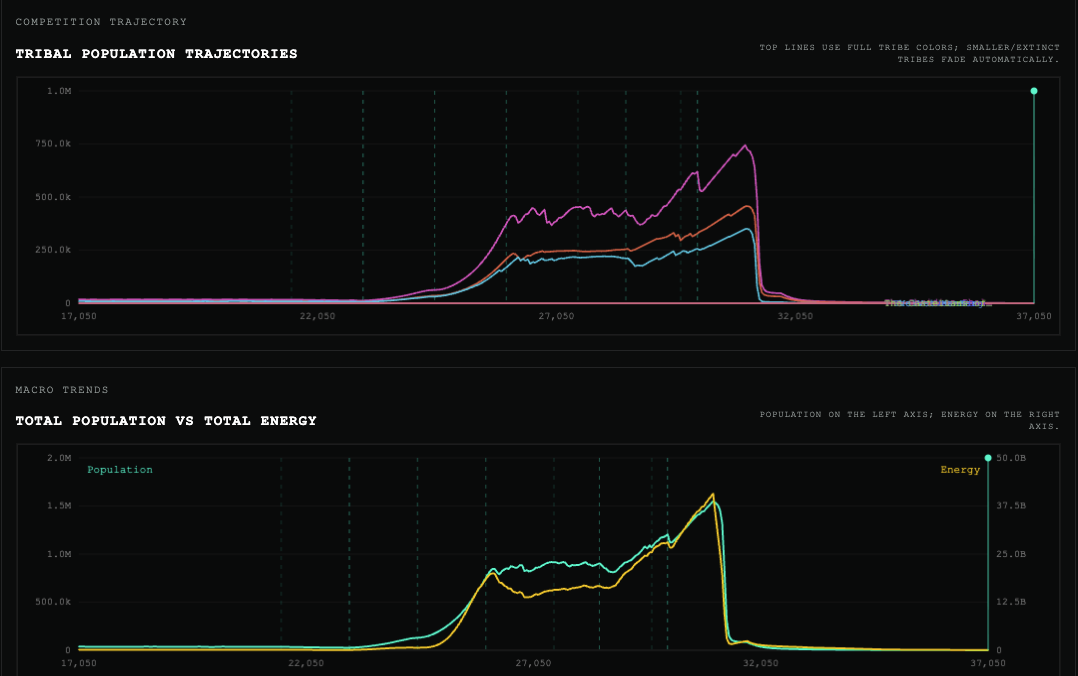
Project 1 establishes the reference world: baseline geography, bottleneck geography, a controlled duel, and climate-severity comparisons. It shows emergence, overshoot, collapse, and agrarian refugia as the recurring baseline pattern.
Open sectionIs survival intrinsic, opponent-specific, or context-dependent?
Project 2 separates solo viability from competitive displacement through all-LLM solo tests, duels, and triads. It shows that a tribe can survive alone and still die beside the wrong neighbor.
Open sectionCan intelligence learn from extinction and redesign better founders?
Project 3 gives LLM designers evidence from prior runs and lets them redesign their founding agents. The lineages evolve toward hardiness, low legacy, internal cohesion, and collapse-survival traits.
Open sectionCan evolved survivors endure the delayed consequences of civilization?
Project 4 adds aerosol demasking, Arctic methane release, nuclear meltdown, and the stacked condition. Survival remains possible, but recovery to high-complexity civilization becomes much harder.
Open sectionWhat kind of future remains after collapse?
The Epilogue tests Ares, natural network collapse, 80,000-pulse futures, reservoir calibration, and the final climate-reservoir projection. It distinguishes survival from recovery.
Open section