Results highlights

What did the artificial histories reveal?

The results should be read as model findings: repeated patterns inside a structured world. They do not predict the real future, but they do expose recurring tensions among cooperation, competition, energy, climate, and inheritance.

These numbers summarize patterns inside the Crucible 2026 study. Each epoch is one complete artificial history. The figures below are not forecasts; they are reference signals from repeated simulation runs under defined experimental conditions.

Baseline end state10 / 10Every Project 1 baseline epoch ended with one surviving tribe.
Average baseline peak2.44MAverage peak population in the Project 1 Set A reference world.
Default tail remaining1.88%Average final population as a share of peak population in the baseline world.
Relational competition10 / 30Project 2 duel epochs with at least one lead reversal.
Ares first field test8 / 10Ares survived eight of ten initial Epilogue field-test epochs.
Final reservoir survivors3 tribesAres, Obsidian, and Ember survived at least once in epochs 231–240.

Population and energy: boom, crash, tail

MACRO_TRENDS
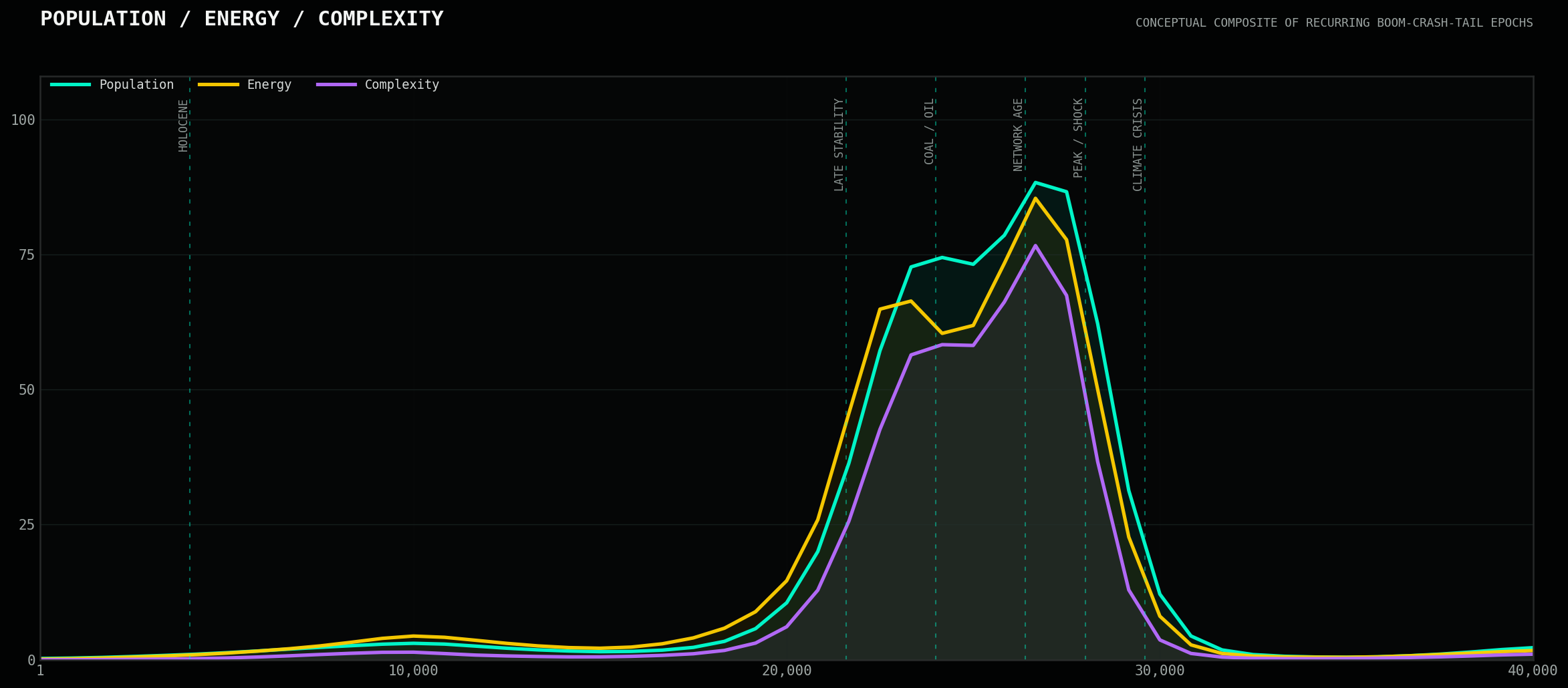
Conceptual Crucible results chart showing population, energy, and complexity rising, peaking, crashing, and leaving a low tail.

The recurring macro-shape is emergence, rapid scaling, peak complexity, crash, and some form of final refugia. The exact depth of the tail depends heavily on climate severity, delayed shocks, and reservoir settings.

Climate tail pressure

HEAT_DAMAGE_CHAOS
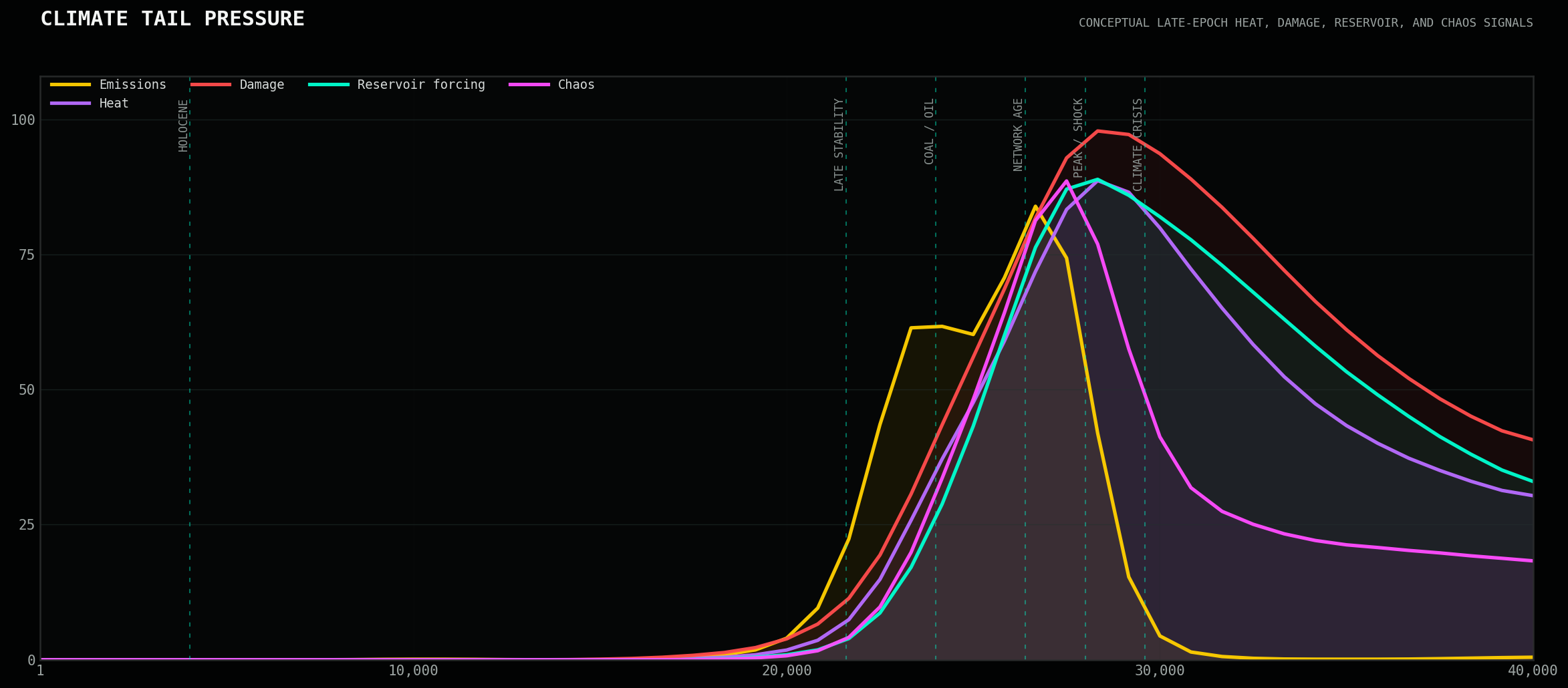
Conceptual Crucible results chart showing emissions, heat, damage, reservoir forcing, and chaos through the late climate tail.

Climate does not explain everything, but it strongly controls how much future remains after the peak. Gentler tails allow larger low-energy equilibria. Harsher reservoirs compress survival into tiny refugia.

General findings

SYNTHESIS
01

Civilization emerges

Designed agents repeatedly build population, complexity, agriculture, industry, and technological regimes under the right conditions.

More

The first important result is that the world does not stay inert. From small founding populations, the simulation repeatedly produces large populations, regional complexity, regime transitions, and technological peaks. Civilization is therefore an emergent product of the coupled world engine, not a fixed outcome inserted by hand.

That emergence matters because it gives the later collapse results weight. The study is not merely killing fragile starting populations. It is allowing agents to build scale first, then testing what that scale can and cannot survive.

Evidence snapshot: Project 1 Set A averaged 2,439,589 peak population and 1,548,409 peak complexity, with population peaks clustered around pulses 29,150-29,300.
02

Pluralism narrows

Many worlds begin with multiple tribes but repeatedly end in one-lineage or near-one-lineage refugia.

More

The Crucible often begins with a broad field of lineages, but durable plural survival is rare in the tested conditions. Geography can delay contact, change the route, and alter the winner list, but it does not automatically preserve a many-tribe world.

This does not mean the winner is predetermined. In fact, different tribes win under different conditions. The repeated pattern is not always the same tribe. The repeated pattern is narrowing itself.

Evidence snapshot: Project 1 Set A ended 10 of 10 epochs with one surviving tribe; Set B also ended with one survivor per epoch, even though six different tribes appeared as winners.
03

Competition is relational

A tribe can be viable alone yet die beside a specific neighbor. Survival is not always an intrinsic property.

More

Project 2 made the competition result more organic than a simple ranking ladder. Some tribes could survive alone but failed when paired against particular opponents. The neighbor changed the path through history.

This is one of the strongest arguments for treating the Crucible as an ecology of strategies rather than a scoreboard. Fitness is partly internal, but it is also matchup-specific, geographic, and historical.

Evidence snapshot: Project 2 recorded lead flips in 10 of 30 duel epochs. Aurora and The Phalanx could survive solo, but duel outcomes still changed the death order.
04

Adaptation works

LLM redesign converges on survival traits, especially hardiness, low legacy, internal cohesion, and controlled movement.

More

Project 3 showed that the designers could learn from extinction evidence. The redesigned lineages moved toward traits the world repeatedly selected: greater hardiness, lower reproductive overshoot, stronger kin cohesion, less outsider exposure, and more controlled movement.

But the adaptation was ambiguous. The lineages became better survivors of collapse, not obvious preservers of stable technological civilization. The study therefore separates intelligence from wisdom: learning can optimize for the world that exists, even if that world rewards endurance after failure more than prevention of failure.

Evidence snapshot: The closing synthesis identifies hardiness, low legacy, internal cohesion, low outsider exposure, controlled movement, and reproductive restraint as repeatedly selected traits.
05

Survival is not recovery

Late survivors often preserve lineage continuity, not technological or civic civilization.

More

The later projects forced a distinction between being alive and being recovered. A lineage can persist biologically while losing high complexity, broad civic structure, and technological continuity. That is still survival, but it is not the same as civilization continuing.

This distinction becomes especially important in the bomb phases and the Epilogue. Some worlds preserve late births or small refugia, but the end state is often low-complexity, narrow, and local.

Evidence snapshot: In the stacked Project 4 condition, evolved LLM tribes survived, but civilizational continuity was not demonstrated; final refugia remained low-complexity and agrarian.
06

The tail matters

The physics after collapse determines whether the future becomes equilibrium, remnant survival, or extinction pressure.

More

The study increasingly showed that the post-peak world is not an afterthought. Climate severity, delayed shocks, and reservoir settings determine how much future is left for behaviour to act within. A good survivor strategy still needs a survivable tail.

That is why the Epilogue mattered. Longer horizons and reservoir conditions tested whether apparent survival was stable or merely delayed failure. The final tail selected a narrow set of lineages and made survival much more conditional.

Evidence snapshot: Default Project 1 climate left 1.88% of peak population, harsher climate left about 0.9%, while gentler climate preserved about 33.7% of peak population.

Leaderboards preview

PUBLIC_SCOREBOARD

The final surviving tribe of any epoch was never fully predictable, but some tribes showed repeated advantage and survivability over others under different conditions. This may have been the most rewarding result of the study: ultimately, behaviour was much more organic than cold, calculated certainty.

Strongest baseline contendersAurora / Fractal Phoenix
Cleanest Project 1 duel winnerSilent Sting
Dominant Project 2 competitorSYMBIONT-ZERO
Best collapse-survival benchmarkObsidian Phalanx Refuge G3
Best Epilogue successor designAres